
A typical Tuesday, Wednesday or Thursday in Mt Lawley, from 9:00 until 3:15.
9:00
Prayer and Bible
Bible stories for the young, Bible study for the older.
Morning lessons
Recess
Lessons
Fitness and silent reading, around lunch
Lunch
Afternoon lessons
3:15
Home
A typical Tuesday, Wednesday or Thursday in 2026, from the school's official timetable. Lessons can change a little by semester — drama and visual art take turns in the afternoon. Class groupings can also change in later years.
The 2026 Pre-Primary class learns with Year 1.
The 2026 Years 4–6 class. (In later years the grouping may change.)
The 2026 high school class.
Three days a week your child learns with us. The other days are at home with you, and you don't need to be a teacher to do them well. Tutors set the home-day work, and you receive a weekly report, so you always know how they're going.
I
Tuesday to Thursday, your child learns in class with their tutors and friends.
II
The rest of the week is at home with you, with work set by the tutors. You don't need to be a teacher.
III
You receive a weekly report, so you always know how they're going.
Parents as co-teachers
You work alongside your child on the home-day work tutors set.
Parents as mentor and supervisor
Your child works more independently while you guide and check in.
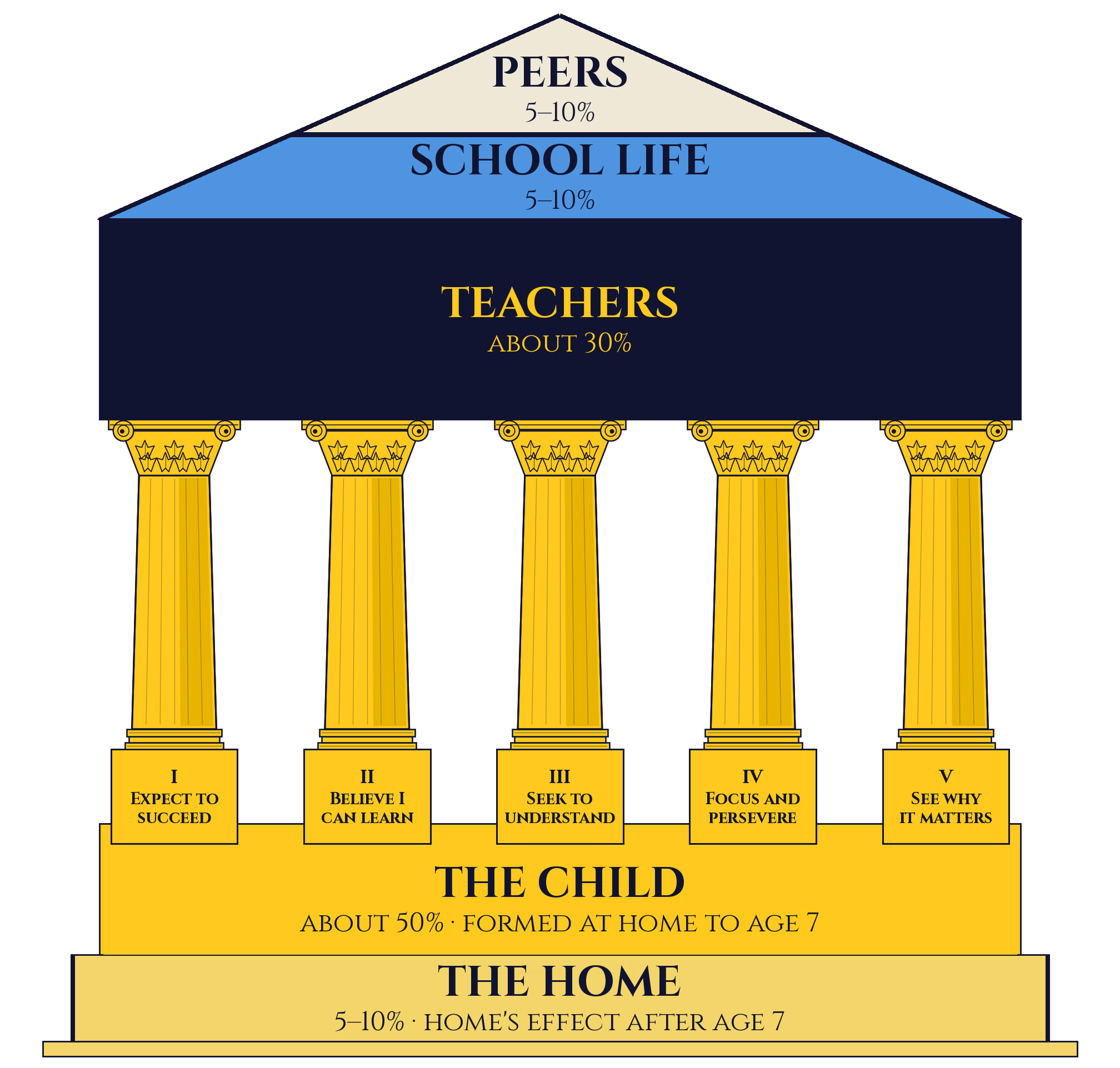 Expecting to Succeed, pillar IConfidence to Learn, pillar IILearning to Understand, pillar IIIFocus and Persistence, pillar IVSeeing Why It Matters, pillar VThe child, about 50 percentThe home, 5 to 10 percentTeachers, about 30 percentSchool and principal, 5 to 10 percentPeers, 5 to 10 percent
What helps children learn? The child matters most, and the early years at home shape what a child brings to school. Tap any part to see how you can help.
Children learn best when home feels calm and predictable.
Regular times for meals, sleep, prayer and work, a quiet place to learn, and screens kept in their place. Calm and order help children settle, so their minds are free to learn.
Research: a review of 112 studies found that noisy, disorganised homes were consistently linked with poorer outcomes for children (Marsh, Dobson & Maddison, 2020).
What you expect, and how you talk about learning, shapes how hard your child aims.
Believing your child can do well, saying so, and talking often about what they are learning and why it matters.
Research: across 25 studies, parents’ hopes and expectations for their child’s education had the strongest link with results, and close supervision at home had the weakest (Fan & Chen, 2001).
Reading together, a little and often, builds words, knowledge and a love of books.
Sharing good books aloud most days: stories, poems, history and Scripture. Children hear richer language than everyday talk gives them.
Research: a review of studies found that reading to young children was linked with stronger language and reading. The effect was greatest before children could read on their own (Bus, van IJzendoorn & Pellegrini, 1995).
A little practice, often, makes learning stick.
The home-day work set by the tutors: short, regular tasks that practise what was taught in class. It is not new teaching.
Research: a review of US homework studies found a positive link with achievement, stronger in Years 7–12 than in the early years (Cooper, Robinson & Patall, 2006).
Step by step, we hand children the reins.
Warm love and clear standards, while giving your child more choices and responsibility as they grow. Children become learners who can manage themselves.
Research: in a study of about 6,400 teenagers, parents who were warm and firm and gave growing independence had children who did better and were more engaged at school (Steinberg et al., 1992).
Children who see their work clearly, and hope to improve, do better.
A fair picture of how they are going, and a real hope that effort and good method will move them on. This is not the same as giving themselves high marks.
Research: parents’ hopes and expectations had the strongest link with children’s results across 25 studies (Fan & Chen, 2001).
Confidence grows from real success at something a little hard.
The belief that “I can learn this,” because effort and good method make a difference.
Research: a major review found that real success at hard tasks is usually the strongest builder of confidence (Usher & Pajares, 2008).
Children learn more when they look for the meaning, not just the answer.
Coming to a task to understand it, not just to finish it.
Research: students who recalled what they had learnt from memory remembered it far better than students who re-read it (Roediger & Karpicke, 2006).
Attention is a habit, and habits grow with practice.
Giving full attention, staying with a task, and coming back to it when it is hard.
Research: in a New Zealand study of about 1,000 children followed to age 32, self-control in childhood predicted better health and finances as adults (Moffitt et al., 2011).
Children work harder when they can see why the work is worth doing.
Finding a task useful, interesting, or part of who they want to be. Their work can serve God and others (“work heartily, as for the Lord,” Colossians 3:23).
Research: when parents were shown why maths and science matter, their teenagers took nearly one extra semester of those subjects (Harackiewicz et al., 2012).
What a child brings to learning matters most of all, and it can grow.
About half of the differences in how well students do come from the child: what they know, their habits, and what they believe about learning. The five pillars are the parts that can grow.
Research: “It is what students bring to the table that predicts achievement more than any other variable” (Hattie, 2003).
After the child, the teacher makes the biggest difference.
Good teachers teach in small, clear steps and check that every child is following. The eight skills are:
Ask your child to teach you one thing they learnt. Explaining it again makes it stick.
Research: teachers account for about 30% of the differences in achievement (Hattie, 2003). The skills follow Rosenshine’s principles of instruction (2012).
Good leaders put teaching and learning at the centre.
We aim to lead this way, with teaching and learning at the centre.
Talk with us about how the week is going, and tell us what is working.
Research: a review of 27 studies found leaders who focus on teaching and learning help students most (Robinson, Lloyd & Rowe, 2008).
Good classmates help each other learn.
Bullying, which harms mental health. Constant comparison with others. Phones and distraction in class.
Ask “Who did you help today? Who helped you?”
Research: a review of 148 studies found that working together led to higher achievement and better friendships than competing or working alone (Roseth, Johnson & Johnson, 2008).